Every bag looks organized on the day you buy it. A few weeks in, it's a flattened wallet buried under a phone charger, half a granola bar, four old receipts, and a hair tie that somehow migrated in from somewhere else entirely. That drift isn't a sign you need a bigger bag, or a pricier one — it's a sign the bag has no actual system, just one compartment absorbing whatever gets dropped into it. A handful of small zones, set up once and refilled the same way every time, is what keeps a bag organized past the first week.
Start with a full dump-out
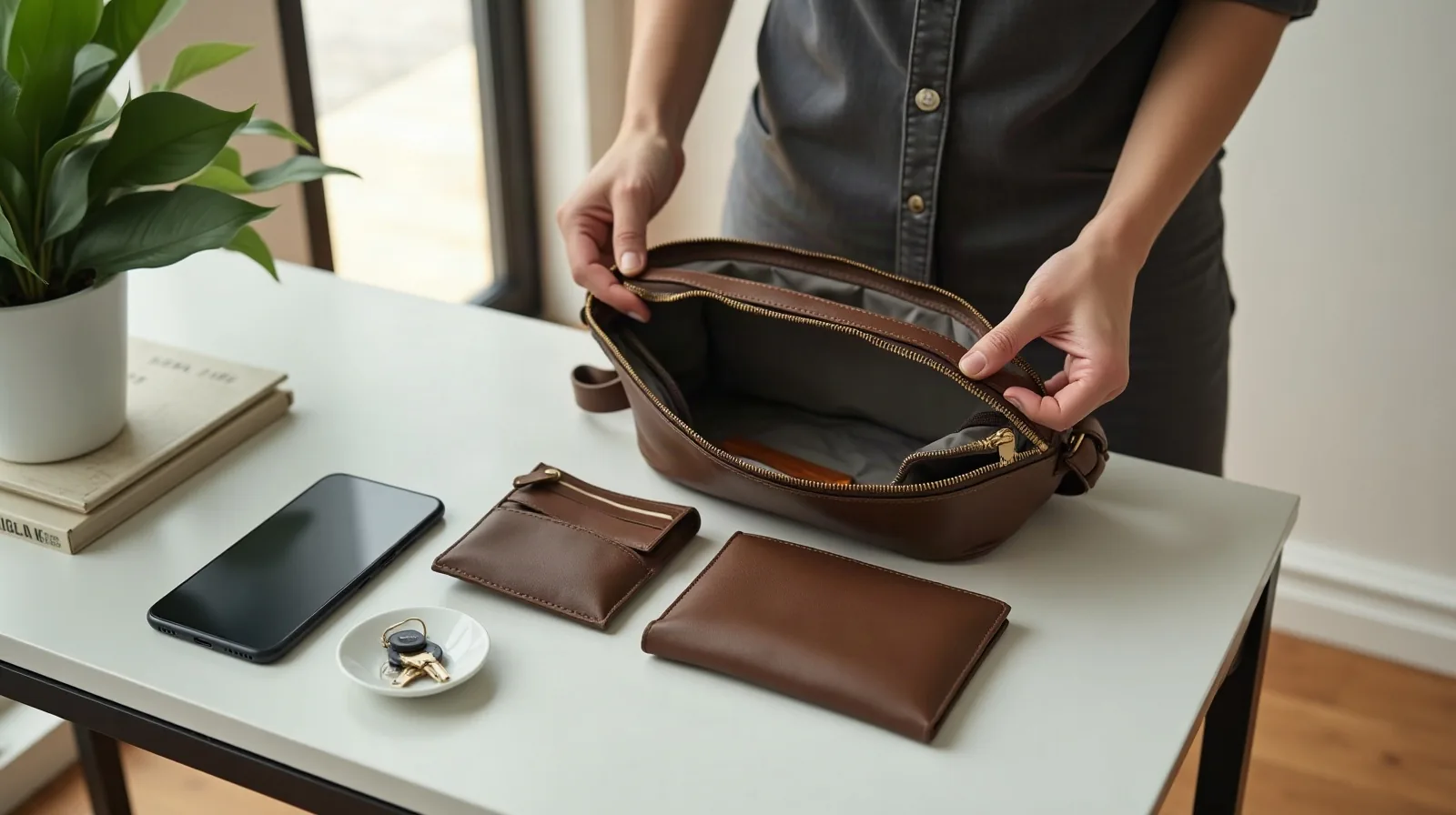
You can't organize a bag by feel, one item at a time — you have to see everything in it at once. Empty every pocket onto a table, not just the main compartment; the side pockets and the bottom seam are where the oldest stuff hides. Sort what comes out into three piles: things that belong in this bag every single day, things that snuck in for one specific outing and never left (a boarding pass, a swim cap, a program from an event two months ago), and straight-up trash — gum wrappers, a dead pen, a receipt gone soft at the folds. The middle pile goes back to wherever it actually belongs; the trash pile goes in the bin. What's left is the real, current contents of your bag, and it's almost always a smaller pile than you expected.
Give every category its own pouch
The reset never holds if everything goes back into one open compartment — that's the exact setup that got you here. Instead, split what's left into a few small pouches, each holding one category and nothing else: an essentials pouch for your wallet, keys, and any transit or membership cards; a tech pouch for a charging cable, earbuds case, and a portable battery; a personal-care pouch for hand sanitizer, a pain reliever, a bandage, and lip balm. Four pouches is usually enough for most people's day-to-day; fewer than three and the categories blur back together. The point isn't the pouches themselves — it's that finding your keys becomes reaching into one specific pouch, not patting down the whole bag.
Pick pouches you can identify without unzipping
A pouch system only saves time if you can tell pouches apart at a glance, ideally without opening any of them. Give each category a different color, fabric, or shape — a bright pouch for essentials, a clear-paneled one for tech so you can see cords before you dig for them, a distinctly textured one for personal care. Matching pouches in four identical shades of black defeats the purpose; you'll end up unzipping all four to find the one you need, which is the same problem as the single open compartment, just moved down one level.
Give the wildcard pocket a hard limit
No system covers every single day, so it's worth keeping one flexible pocket for whatever that particular day calls for — an umbrella, a snack, a paperback, a spare mask. The catch is giving it a real size limit: one small pocket or one small pouch, not "the rest of the bag." A wildcard zone without a cap is just a junk drawer with better branding — it quietly expands until it's swallowed the essentials pouch's job too. When the wildcard pouch is full, something comes out before something new goes in.
What doesn't belong in an everyday bag at all
Some things accumulate in a bag purely because removing them never felt urgent. Receipts you don't need for a return or a warranty can be photographed and tossed the same day. Physical loyalty cards are increasingly duplicated by an app or a phone number lookup at the register — check before you keep carrying the plastic. A second or third lip balm, an old boarding pass, a charger for a device you retired last year, expired coupons — none of it is doing anything for you sitting at the bottom of a pouch. Apply a version of one-in-one-out to the bag itself: if something new earns a permanent spot, something that hasn't been used in the last month or two earns an exit.
The one-minute reset that keeps it working
The pouches do most of the work, but they still need a quick check-in or they drift the same way the open compartment did. By the door, once a day or every other day, it takes about a minute to pull out anything that clearly doesn't belong — a receipt, a wrapper, a stray toy that ended up in there. Once a month, do the full dump-out again: it's faster the second time, because the categories already exist and you're mostly just confirming nothing has crept past its pouch.
None of this requires buying a matched set of organizer pouches or overhauling your bag on day one. Pick four categories that match how you actually use what's in there, put one item type in each pouch, and give the wildcard a real limit. The system does the remembering after that — you just have to put things back in the pouch they came out of.