
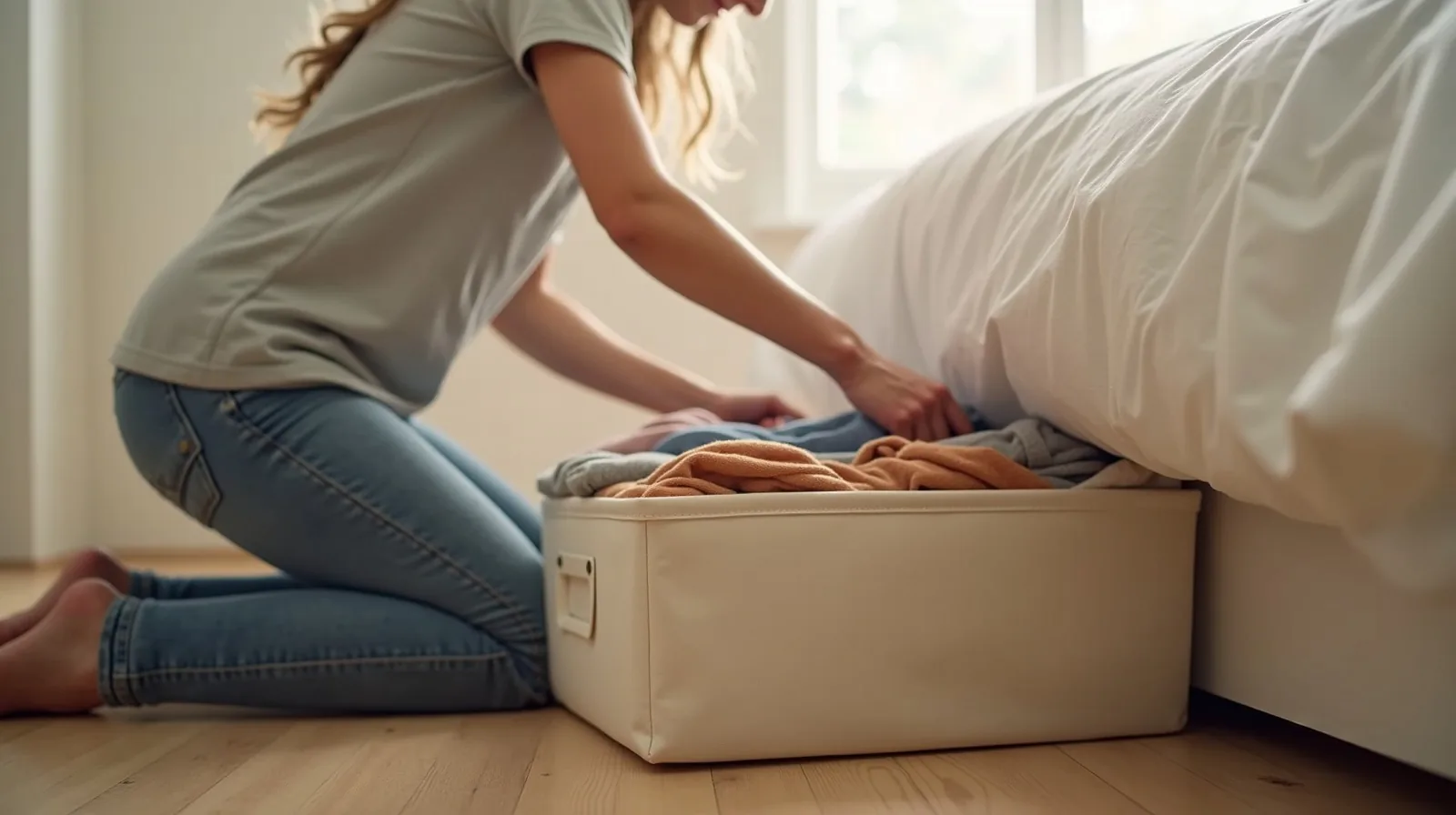
Under a standard bed frame sits roughly the same footprint as a small closet — and in most homes it’s either dead air or a chaotic slide of loose shoeboxes and stray bags that nobody wants to reach into. That’s a shame, because with the right containers and a little planning, under-bed storage can hold a genuinely useful stash without turning into the place lost socks and dust bunnies go to retire. A little upfront thought about what goes in, how it’s contained, and how it’s labeled turns this awkward gap into some of the most efficient storage in the whole house.
What actually belongs down there
The best candidates for under-bed storage are things you need access to only occasionally, don’t need to see at a glance, and won’t be damaged by a little temperature swing or the low-traffic dust that collects near the floor.
- Off-season clothing. Heavy sweaters in summer, shorts and swimwear in winter — anything you’ve already sorted out of the active closet rotation.
- Spare bedding. Extra sheet sets, blankets, and pillows you use a few times a year, especially guest linens.
- Flat, seasonal items. Gift wrap, holiday table linens, and other things that lie flat and don’t get squished by being stacked.
- Luggage-nested extras. Empty duffel bags or a spare suitcase, ideally with smaller items nested inside to use the space twice.
What doesn’t belong: anything you reach for weekly, anything that needs to breathe (down items can flatten and smell musty if sealed too long without airing), and anything valuable enough that you’d want to check on it regularly. If you have to move furniture or lie on the floor to get to something, it should be something you rarely need. A good rule of thumb: if you can picture needing it on a normal Tuesday, it belongs somewhere with easier access, not under the bed frame where retrieving it means getting down on the floor.
Containing the dust problem
The reason under-bed storage earns its bad reputation is usually the container, not the location. A loose stack of items directly on the floor collects dust on every exposed surface and turns into a project every time you need something. A lidded bin solves most of this on its own — it seals the contents away from dust, pet hair, and whatever else drifts along baseboards, and it gives you one clean surface to pull out instead of a sliding pile.
A few features are worth prioritizing when you choose bins: a low profile that actually clears your bed frame (measure first — see below), a lid that seats securely rather than one that pops off when the bin catches on the frame, and ideally rollers or a smooth base so you’re not dragging a full bin across carpet fibers. Clear bins let you glance inside without opening; opaque fabric bins hide contents but are lighter and quieter to slide. Either works — the labeling below matters more than which one you pick. It’s also worth choosing a bin depth that leaves a finger’s width of clearance rather than an exact fit, since carpet pile and mattress sag both eat into the number on your tape measure over time.
Measure before you buy
Nothing wastes more money than a bin that doesn’t fit. Bed frame clearance varies enormously — a platform bed might leave four inches, while a bed on risers can clear over a foot. Before buying anything, get down and measure the actual clearance at the lowest point, not just at the headboard, since center support bars and box springs often hang lower than the frame’s edges. Measure width too, so you know how many bins will fit side by side without overlapping the center support.
Buy one bin first as a test if you’re unsure. It’s a small delay that saves the annoyance of returning a whole set that’s a half-inch too tall to slide freely. Check both sides of the bed too — frames aren’t always perfectly level, and a bin that glides on one side can snag on the other if the mattress or box spring sags unevenly toward the middle.
Label for a space you can’t see into
Once a bin is under the bed, it’s effectively invisible — you won’t remember which one has the winter sweaters versus the guest sheets after a few months. A simple label on the end that faces out when the bin is slid home solves this instantly: a word or two is enough (“Winter clothes,” “Guest linens”), and it means you never have to pull out three bins to find the right one. If you use matching bins for different categories, a different label color per category makes the right one identifiable at a glance, even in a dim room.