
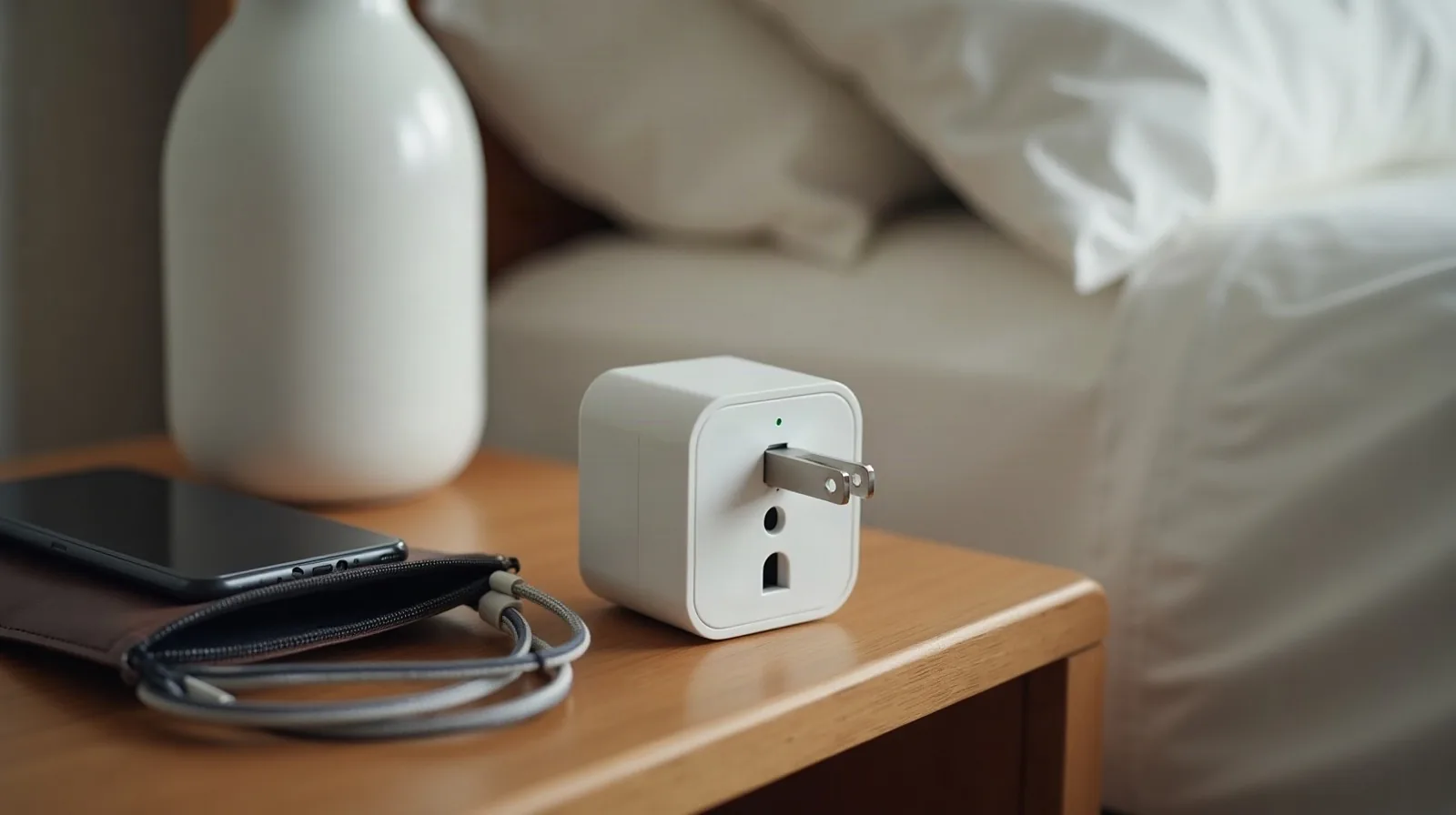
You've packed the right clothes, downloaded the map, and saved every confirmation — then you get to the outlet and stare at prongs that don't match. A plug adapter is the easy half of the problem, because it's obvious the second you look at the wall. Voltage is the part that quietly wrecks a device, because nothing about the outlet or the adapter warns you it's the wrong power entirely. Sorting out which one you actually need takes about ten minutes before you pack, and it's the difference between a working charger and a short, expensive lesson.
Adapter or converter — you're probably only missing one
These solve two completely different problems, and travel shops love to blur the line so you buy both. A plug adapter changes the shape of the plug so it physically fits a different outlet — it does nothing to the electricity itself. A voltage converter actually changes the power coming out of the wall, stepping it up or down so a device built for one voltage range can safely run on another. Most travelers only ever need the first one. The second matters for a shrinking list of devices, covered below.
Reading a plug: the shapes that actually matter
Outlet shapes vary by country, but in practice they fall into a handful of families: two flat parallel blades (much of the Americas and parts of Asia), two round pins (most of continental Europe and much of Africa), three rectangular pins in a triangle (the UK, Ireland, and a few former territories), and a couple of regional variants with their own quirks, like Australia's angled blades. A single universal adapter — the kind with a sliding or interchangeable face — covers nearly every region in one compact unit, which beats packing a separate single-country adapter for every stop on a multi-country trip.
Voltage is the part that actually causes damage
Here's what a plug adapter can't fix. Electrical grids run on one of two main voltage ranges: roughly 100–127 volts (North America, parts of Central America and Asia) or roughly 220–240 volts (most of Europe, Africa, Asia, and Australia). Plug a device built only for the lower range into the higher one, and depending on the device, you'll get anything from nothing happening to a genuinely fried gadget.
The fix isn't complicated: check the label. Almost every phone charger, laptop charger, and camera charger sold in the last decade prints its accepted input range right on the brick — something like “100–240V.” If you see a range like that, the device is dual-voltage and only needs a plug adapter, no converter, anywhere in the world. If the label lists a single number instead of a range, that's your signal to keep reading.
What almost never needs a converter
Anything with a small, modern power brick is almost certainly dual-voltage already: phone and tablet chargers, laptop chargers, camera and drone battery chargers, electric toothbrush chargers, and most portable speakers and battery packs. Check the input line on the brick once before your first trip abroad, and if it lists a wide voltage range, you're set for every future destination for the life of that charger — all you need at that point is the right plug shape to physically connect it.
What genuinely does (or should stay home)
The devices that actually need a converter are the ones that heat, cool, or spin at high power without a smart internal power supply — hair dryers, flat irons, curling irons, some electric shavers, and small kitchen gadgets are the usual culprits. These often run on a fixed voltage only, and a heavy-duty converter big enough for one of them is bulky, runs hot, and can still overheat or trip a circuit if it's used for too long at a stretch. For a single trip, it's almost always cheaper and lighter to buy a basic version locally, or a genuinely dual-voltage travel model, than to haul a full-size converter and its fire risk through security.
Packing it so you're not caught out
- One universal adapter beats several country-specific ones on any multi-country trip — less to lose, less to sort through at the outlet.
- Check the voltage label on every device before you fly, not after you land. It takes seconds and it's the whole ballgame.
- Pack the adapter in a carry-on, not checked luggage, so a delayed bag doesn't strand your phone at 2%.
- A model with built-in USB ports means one adapter can feed several small devices from a single outlet — useful in hotel rooms that never have enough sockets near the bed.
- Know whether yours is adapter-only or has a built-in converter. A plain adapter passes through whatever voltage is in the wall; plugging a single-voltage device into one is exactly the mistake that fries it.
The plug is the part you can see, so it's the part everyone remembers to solve. Voltage is invisible until it isn't — and by then it's usually too late for the device. Check the label on what you're bringing, pack one good universal adapter, and save the bulky converter for the rare gadget that actually earns it.